Scott Hartman

Scott Hartman

Paleobiologist & vertebrate paleontologist
Instructional Faculty III · Department of Biology · University of Wisconsin–Madison

I study how vertebrates work, from the anatomy and physiology of dinosaurs in general to the origin of avian flight, using phylogenetics, biomechanics, and mechanistic physiological models.

Research All research →
Publications All 40 →

2000 · Primary and caudal feathers as locomotory adaptations in maniraptoran theropods2003 · Evidence for costal pneumaticity in a diplodocid dinosaur (Supersaurus vivianae)2004 · A new diplodocid braincase (Dinosauria: Sauropoda) from the Morrison Formation of north-western Wyoming2004 · Stance and carriage in Brachylophosaurus: evidence from articulated specimens2005 · Phylogenetic assessment of a maniraptoran from the Morrison Formation2005 · Revised osteology of Supersaurus vivianae2006 · Duckbill dinosaur chin skin scales: ups, downs and arounds of surficial morphology of Upper Cretaceous Lance Formation dinosaur skin2006 · Estimating osteological neutral position in sauropod axial skeletons: comparing two-dimensional and three-dimensional methods of analysis2006 · Late Cretaceous duckbill mandibles and duckbill dinosaur chin skin scales: cheeks, chewing kinetics, and skin2006 · Utilizing 3D laser scans and commercially available software to create and analyze virtual morphological data sets2007 · The tenth skeletal specimen of Archaeopteryx2007 · Morphology of a specimen of Supersaurus (Dinosauria, Sauropoda) from the Morrison Formation of Wyoming, and a re-evaluation of diplodocid phylogeny2007 · Re-evaluating wing shape in Archaeopteryx: information from the Thermopolis specimen2010 · A new chasmosaurine ceratopsid from the Judith River Formation, Montana2012 · Investigating the impact of competing interpretations of pectoral girdle placement and appendicular function on sauropod head height2013 · All Yesterdays: unique and speculative views of dinosaurs and other prehistoric animals2015 · An overview of non-avian theropod discoveries and classification2015 · Using ecological modelling to quantify thermal constraints on two Late Triassic dinosaurs2016 · Mechanistic physiological modelling predicts geographic distribution of Late Triassic tetrapods2016 · Nothing but skin and bones: Anchiornis body outline revealed by laser fluorescence2017 · Basal paravian functional anatomy illuminated by high-detail body outline2017 · New information on a paravian theropod from the Morrison Formation2018 · A testable macroevolutionary framework for character acquisition in the origin of avian flight2018 · Adaptive diversity in the early evolution of theropod flight2018 · Laser-stimulated fluorescence reveals preserved soft tissues which unravel the complexity of avian flight evolution2019 · A new paravian dinosaur from the Late Jurassic of North America supports a late acquisition of avian flight2019 · Lower rotational inertia and larger leg muscles indicate more rapid turns in tyrannosaurids than in other large theropods2019 · Internal and external flight-related anatomy of early theropod fliers revealed by laser-stimulated fluorescence fills knowledge gaps in functional morphology and flight capability2019 · Origin of Pterosauria and stepwise evolution of the pterosaurian flight apparatus2020 · Modeling Dragons: using linked mechanistic physiological and microclimate models to explore environmental, physiological, and morphological constraints on the early evolution of dinosaurs2020 · Macroevolution, thermal ecology and extinction in terrestrial Mesozoic tetrapods2021 · A clarification of rabbit shoulder musculature for teaching functional anatomy2021 · Operationalizing a late origin of avian flight2021 · Thermal ecology drove survivorship patterns of terrestrial vertebrates across the end-Triassic extinction2022 · Mechanistic Thermal Modeling of Late Triassic Terrestrial Amniotes Predicts Biogeographic Distribution2022 · Preserved soft anatomy confirms shoulder-powered upstroke of early theropod flyers, reveals enhanced early pygostylian upstroke, and explains early sternum loss2025 · Forelimb feathering, soft tissues, and skeleton of the flying dromaeosaurid Microraptor2025 · New information on the hind limb feathering, soft tissues and skeleton of Microraptor (Theropoda: Dromaeosauridae)2025 · New Microraptor specimens bring insight into the forewing anatomy and its impact on flight behavior and ecology2025 · Transition from occasional to habitual theropod flyers: origin of regular flight use in early birds and their close relatives
Paper, chapter, book, or thesisConference abstract or talkSelected, below
  1. 2022

    Mechanistic Thermal Modeling of Late Triassic Terrestrial Amniotes Predicts Biogeographic Distribution

    Hartman SA, Lovelace DM, Linzmeier BJ, Mathewson PD, Porter WP

    Diversity 14(11): 97310.3390/d14110973

  2. 2022

    Preserved soft anatomy confirms shoulder-powered upstroke of early theropod flyers, reveals enhanced early pygostylian upstroke, and explains early sternum loss

    Pittman M, Kaye TG, Wang X, Zheng X, Dececchi TA, Hartman SA

    Proceedings of the National Academy of Sciences 119(47): e220547611910.1073/pnas.2205476119

  3. 2020

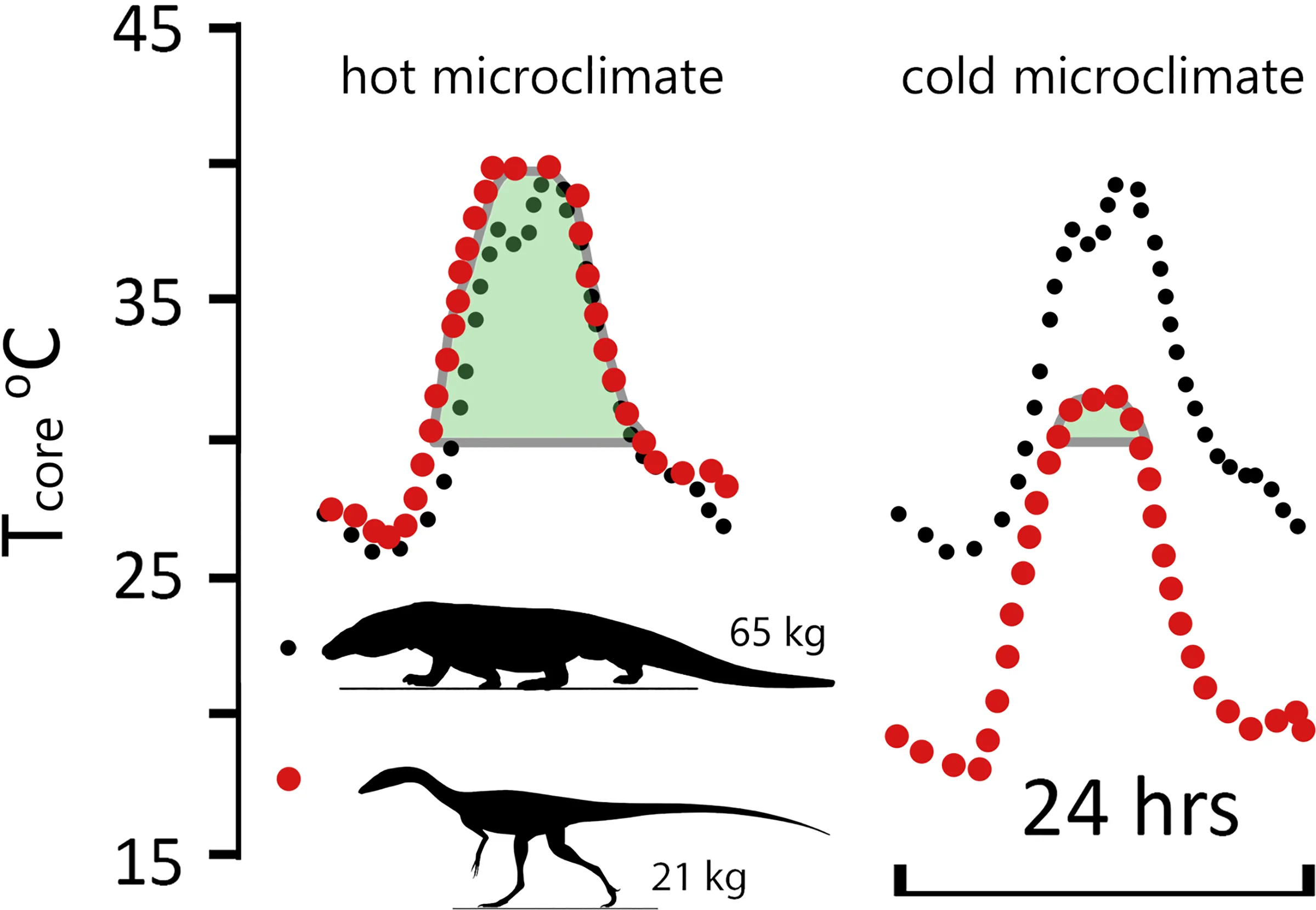
    Modeling Dragons: using linked mechanistic physiological and microclimate models to explore environmental, physiological, and morphological constraints on the early evolution of dinosaurs

    Lovelace DM, Hartman SA, Mathewson PD, Linzmeier BJ, Porter WP

    PLOS ONE 15(5): e022387210.1371/journal.pone.0223872

  4. 2019

    A new paravian dinosaur from the Late Jurassic of North America supports a late acquisition of avian flight

    Hartman S, Mortimer M, Wahl WR, Lomax DR, Lippincott J, Lovelace DM

    PeerJ 7: e724710.7717/peerj.7247

News Archive →